

| smartfire |
Home |
Capabilities |
Features |
Background |
Future |
Projects |
Publications |
Animations |
News | Press Releases | Leaflets | Team | Visitor Registration | Demo Software | Users Area | Contact |
 |
FUTURE DEVELOPMENTS
SMARTFIRE Research and New features currently under development
Automated Solution ControlFire Product Deposition Modelling
Coupled CFD and Zone Modelling
Enhanced SMARTFIRE to EXODUS Data Linkage
SMARTFIRE
Research and New features currently under development Back
The SMARTFIRE group undertake considerable and diverse research into issues associated with fire, combustion and CFD modelling. This research includes:
- Research into the development of improved numerical schemes in order to make fire modelling more efficient,
- Research into the development of improved user environments in order to make fire field modelling more effective,
- Research into the development of solid fuel combustion models,
- Research into fire spread models and simple structural interaction,
- Research into the development of fire-sprinkler/mist interaction models,
- Continuing research into smoke and toxic gas generation (and transport) in fire scenarios,
- Laboratory scale fire tests with collaborating organisations, etc.
The group is involved in applying all of these capabilities in aviation, building, rail and marine environments. This work is often undertaken in collaboration with other research organisations. For an indication of some of the projects we are working on visit our FSEG Research Projects pages.
Listed below are a range of new features that are currently being developed. Most of these features exist in prototype format within the SMARTFIRE software and are scheduled for release in subsequent versions.
Automated Solution Control : The Intelligent Control System (ICS) and the Experiment Engine: Back
This research is directed at the use of Artificial Intelligence (AI) techniques to assist in dynamic solution control of fire scenarios being simulated using SMARTFIRE. Its main aim is to improve the automatic convergence capabilities of the software while further decreasing the computational overheads. The technique automatically controls solver relaxation using an integrated production rule engine with a blackboard (current solution status) to monitor and process the required control changes as the solution progresses. Results from the research have showed great potential for considerable savings in simulation run-times when compared with control sets from various sources, e.g. CFD experts, etc., and furthermore higher accuracy solutions are obtained in the process. The approach demonstrates enhanced solution reliability due to obtaining acceptable convergence within each time step as compared to the conventional approaches. The control architecture is described in the figure above. There are two alternating stages in Intelligent Control System (ICS)-controlled simulations:
Monitoring Phase, where no
control actions are performed but the time steps are
monitored for signs of developing problems
Search Phase, where the modifications are proposed and
tested. The search results are then evaluated and
eventually the best control parameters applied.
In complex three-dimensional fire modelling examples, this approach has reduced the overall iteration count by 50%, which in return is an overall saving of some 50-60% of the CPU time. Furthermore, solutions are generated that have meet the convergence criteria 100% compared to traditional approaches where solution may reach the maximum number of iterations within a time step and simply move onto the next time step.
|
The search procedure for Automatic Dynamic Control KBS. |

The second development is the new Experiment Engine. This is a computational module that can act as an expert assistant to provide high level solution control from the point at which the geometry and the nature of the simulation have been specified. The concept here is that the Experiment Engine will be able to run a coarse mesh, simplified model to determine such issues as the likely stability, ranges of data and solution complexity. This information can then be used to enhance the performance of the mesh generation (via cell budget control and local refinement) and the subsequent numerical processing and solution control (such as configuration of time stepping and relaxations).
Unstructured Meshing: Back
At the heart of SMARTFIRE is an unstructured mesh CFD code. This means that SMARTFIRE can solve the fire equations on very complex computational meshes. This enables the software to model fires in complex irregular structures such as large warehouses with pitched roofs or the extremely complex environment of an aircraft cabin. Furthermore SMARTFIRE will be able to support any type of computational mesh composed of arbitrary polyhedral volumes including but not limited to tetrahedral and hexahedral bricks. However, construction of some unstructured meshes currently requires the use of third party geometry specification and meshing software. Work is currently underway to develop suitable user-interfaces that allow mesh specification to be performed in as simple a manner as the current regular mesh generation is within SMARTFIRE.
|
Warehouse fire simulation (with ceiling vents) simulated using the unstructured mesh version of SMARTFIRE. |

|
Unstructured tetrahedral mesh elements (Pyramids), has been used in the unstructured mesh version of SMARTFIRE to simulate the effects of fire within aircraft. The mesh was generated using a third party mesh generator. |
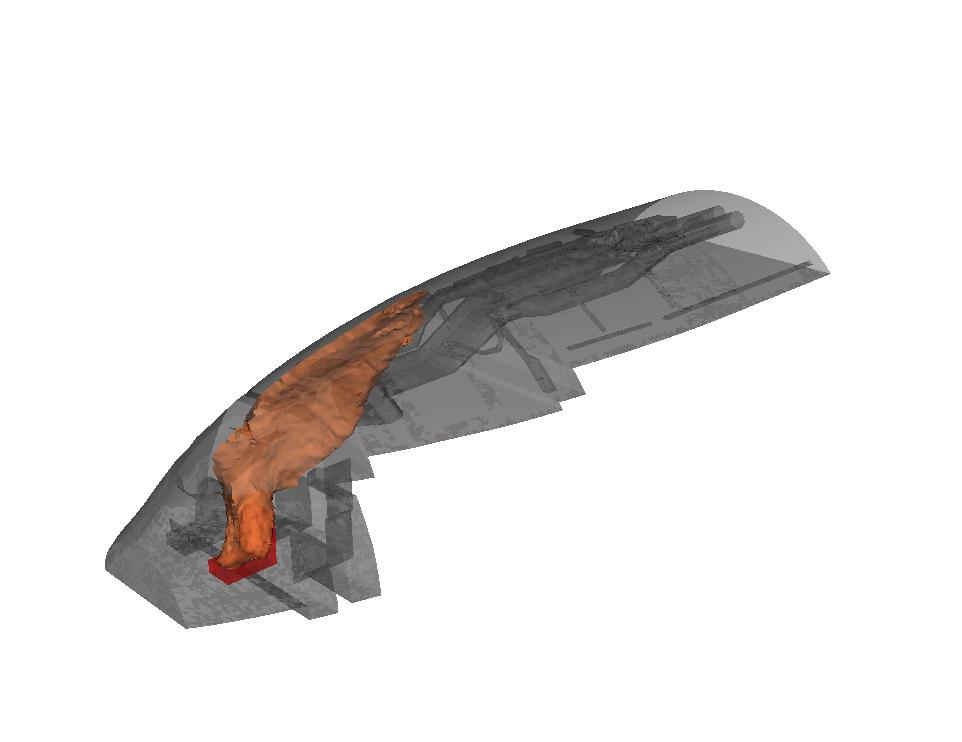
Simulation of fire within an aircraft cockpit using an unstructured mesh. Depicted is a VR representation of the aircraft with a temperature isosurface. Some notable features in the geometry include the pilots chair and ducting in the above ceiling region. Visualised using MayaVi. |
|


|
Decomposing an unstructured mesh of the MD11 scenario for simulation in the Parallel version of SMARTFIRE. |

The researchers in FSEG are
currently working on a number of approaches to handle
the difficulties of unstructured geometries. One
prototype approach uses a Google Sketch-Up building as a
starting point and demonstrates how the geometry can be
manipulated and filtered to create a compatible SMARTFIRE
simulation scenario.
|
An "unstructured" house geometry in Google Sketch-Up. |
|
The house geometry has been saved and then meshed in the Harpoon Meshing System. |
|
Another meshed house geometry is configured as a scenario and then run in SMARTFIRE CFD Engine. |
|
Completed simulation results visualised in DataViewer. |


Fire Product Deposition Modelling: Back
Fires typically generate a number of narcotic and toxic gasses. Sometimes these products of combustion have complex behaviour which means that the dispersion and transport of the products (within the flow domain) is non-trivial. For HCL, the gas reacts with certain wall surfaces to effectively remove it from the gaseous phase. This needs to be accurately modelled in order to predict the gaseous quantities of HCL which can be convected into other regions of the geometry and so cause harm to occupants.
Galloway and Hirschler’s deposition model, typically used in zone models, is modified and applied to a field fire model in order to predict the decay of HCL within fire enclosures. The modified model still uses empirical formulas, but the HCL deposition mechanisms have been simplified from three processes to two processes (see Figure below).
|
|

The effect of HCL flux to the wall boundary, on the time to reach equilibrium (i.e. for the wall surface HCL density to rise and reach the equilibrium) is addressed in this modified model. The new model correctly predicts the absorption of HCL by wall surfaces with the SMARTFIRE Fire Field Model.

SMARTFIRE modelling HCL absorption showing surface map when using PMMA walls |

SMARTFIRE modelling HCL absorption showing surface map when using Concrete walls |
Coupled CFD Fire Field Modelling and Zone Modelling: Back
In very large geometries
(e.g. airport terminals, underground stations) there may
be regions of the geometry which will only experience
minor fire impact or which may be of little direct
relevance to the solution outcome. In such cases
it may be desirable to use a coupled field-zone
modelling approach to simplify the calculations and
reduce the computational overhead associated with
simulations based on a pure field modelling
approach. The aim of this project is to develop
such a coupled field-zone modelling approach using SMARTFIRE
as the core field modelling engine. An
advanced prototype Hybrid CFD/Zone computational engine
has been developed and it has demonstrated very good
solution consistency whilst providing excellent
computational time savings as compared to using full CFD
simulation. Current research and development activities
are directed at providing a suitable scenario
configuration for the Hybrid model.
Enhanced SMARTFIRE to EXODUS data linkage: Back
The current SMARTFIRE to EXODUS data linkage relies on the creation of appropriate hazard sub-volumes within both models. These hazard sub-volumes might be very large by comparison to the control volumes used within the CFD model. In such instances there might be considerable local inaccuracy (due to data averaging) within the sub-volumes, particularly when the hazard sub-volumes are close to the fire sources or where there are complex/significant flows.
An enhanced SMARTFIRE
to EXODUS data linkage is currently being
developed which attempts to preserve more of the
computational accuracy of the CFD modelling. The
evacuation software will have access to a more
spatially-resolved database of results data for each
time step which it can interrogate to determine more
representative hazard values. Although the spatial
resolution of the hazard export could be as small as a
single evacuation node space, this would typically
result in exporting rather more hazard data than is
strictly necessary.
Sprinkler and Water Mist Modelling: Back
Sprinkler and Water Mist models developed by FSEG for the EU funded FIREDASS project have been ported to the SMARTFIRE software. Ongoing research is aimed at investigating droplet interaction with the gas environment, droplet interaction with burning surfaces and fire suppression effects. Although Sprinkler and Water Mist system modelling is now available, Fire Suppression and enhanced coupling between sub-models will be made available to users in future releases of the software after thorough validation has been performed.
|
Investigating the effect of sprinkler head design for Water Mist modelling within SMARTFIRE Research Version. |

Solid Fuel Combustion: Back
Research undertaken by the SMARTFIRE development team into the development of solid fuel combustion models based on the pyrolysis process, and including charring effects, is being incorporated into the SMARTFIRE environment.This research is using an embedded mesh for the fine scale modelling of the thermal conduction and decomposition into the solid fueld surface.
Continuing Research into Toxic Gas Species Generation: Back
Research by the SMARTFIRE developers continues into the application and development of toxic gas generation models based on the Local Equivalence Ratio (LER) concept. The LER based toxicity model has been fully implemented in SMARTFIRE and is currently being extended to model other gaseous species.
The model was first used to predict the CO, CO2 and Optical Density of smoke for a combined CFD analysis and evacuation model performed in SMARTFIRE and EXODUS.
The Equivalence
Ratio φ, is defined as the fuel mass flow rate divided
by the air mass flow rate normalized by the
stoichiometric ratio of fuel to air. φ is used to
describe the vitiated condition within a fire room
Correlation between species yields and φ. Experimental
data support that the yields of combustion products are
correlated with φ. A Correlation between species yields
and φ have been derived from experimental data for
various building materials. This yield correlation is
used to predict the generation of combustion products in
room fires. Preliminary numerical tests showed that this
approach was very promising.
The model performed very well in the Cable fire scenario
with accurate prediction of the product species.

SMARTFIRE modelling CO mass fractions from a cable fire |

Graph showing predicted and experimental CO2 volume fractions for a small room fire test scenario. |
New Features planned for SMARTFIRE
v5.0
Back
A range of new
features for SMARTFIRE v5.0 (and beyond)
are currently in development.
The current list of features under development and testing, includes:
- Fully unstructured workflow : aims to make fully unstructured geometries capable of being simulated within the SMARTFIRE CFD Engine.
- Zone independent data export to Exodus, using significantly greater hazard data resolution for more accurate FED experience by building occupants.
- Parallel visualisation of
large data sets.
More information concerning these features will be provided here in the near future.